- Home
- What we do
- Conservatory air conditioning
Conservatory air conditioning in Ilford
Does your Ilford conservatory sit empty for most of the summer and again through the winter? Conservatories, glazed extensions, garden offices and studios all get the same approach from us: a reversible unit sized for the glass rather than the floor. The room becomes usable on hot afternoons and cold mornings alike.
Ask about the glass room
Leave three details and we phone you to talk it through.
- Sized for the glass, not the floor
- Warm enough to use in winter
- Garden offices and studios included
Why does a glass room need more cooling than its floor area suggests?
Because sizing tables assume walls that keep the sun out. iHeat notes that big expanses of glass, south-facing ones most of all, push up the output required, and a conservatory may be glazed on three sides and overhead. So we size from the area of glass, the direction it faces, the roof material and whatever shade exists, not from square metres alone. Blinds, a solid or tinted roof and solar film all reduce the load, and a smaller load means a smaller unit. The sizing guide covers ordinary rooms for comparison. Source: iHeat.
Where do the indoor and outdoor units go?
The indoor unit normally goes on the original back wall of the house, the only solid surface in the room with any height; a low console on a dwarf wall is the alternative. The pipes pass through or along that wall to an outdoor unit at the side or back of the house. That rear position matters in a conservation area, where permitted development rules out the street-facing walls and roof, and anywhere closer to the road than the building's own front. Source: Planning Portal.
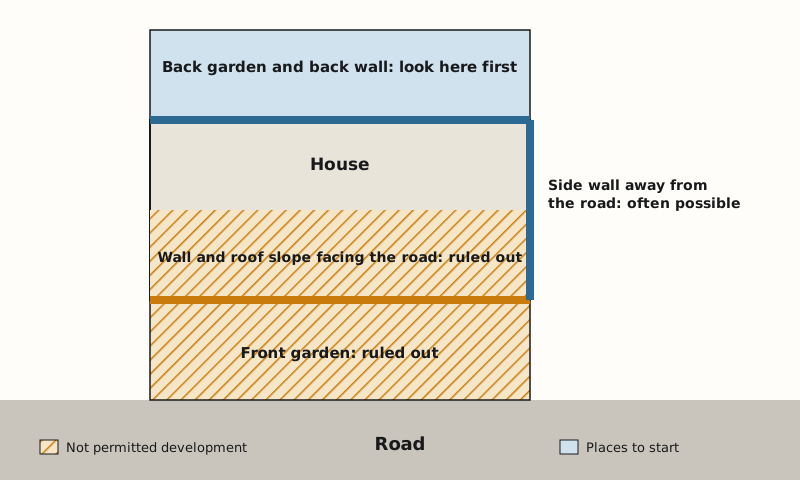
What applies on the Bungalow Estate and in other conservation areas?
Extra controls, so ask before you build or fit. Redbridge has 16 conservation areas. One of them, the Bungalow Estate south of Seven Kings, between Ilford and Goodmayes, was designated as Mayfield on 3 October 1991 and has had an Article 4 direction since 1987 controlling extensions, porches and roof alterations, which reaches a new conservatory; the council also lists a further direction for the estate from 2017. Whether either affects an outdoor unit depends on its wording, so check with Redbridge before relying on permitted development there. Anywhere in a conservation area, the rear and the side away from the street are where to look. A listed building has no permitted development right at all, and work that affects its character needs listed building consent. The borough's protected areas are described under heritage and planning in Ilford. Sources: Redbridge Council; Redbridge Council, Bungalow Estate appraisal; Planning Portal; Listed Buildings Act 1990, s7.
Can the same approach cool a garden office or studio?
Yes, if the building is insulated; a thin timber shed loses cooling as fast as it gains heat. Two things differ from a conservatory. Power: the outbuilding has to have a cable big enough for the load, and a fresh circuit out to the garden counts as notifiable work under Part P. Position: garden rooms tend to sit near a boundary fence, so the outdoor unit may end up close to a neighbour's house. Since 29 May 2025 there is no rule keeping a heat pump a metre from the boundary, but the 37 dB(A) test at the neighbour's nearest window still has to be passed. Sources: IET; Baxi; Grant UK.
Is heating a conservatory with it worth the electricity?
Far more than heating it with a plug-in heater. Running in reverse, the unit turns each kilowatt-hour of electricity into several of heat: the Energy Saving Trust gives typical seasonal heating performance as above 4, where a fan heater manages exactly 1. That makes a cold glass room usable on winter mornings, and there are plenty of those: at Greenwich, about six miles away, air frost averages about 23 days a year. Glass loses heat quickly, so blinds drawn after dark help in winter too. The running costs guide has the sums. Sources: Energy Saving Trust; Met Office.
Common questions
Would a portable air conditioner be enough?
Seldom. A portable vents its waste heat through a flexible hose, usually via a door or window left ajar, in a room that is gaining heat through every pane. It may take the edge off a small, shaded conservatory but not much more.
Is the roof the real problem?
Often it is the largest single source of heat. If a clear roof is failing or unshaded, sorting that first may mean a smaller unit, and we will say so when we visit.
Is permission needed for the outdoor unit?
On a house it comes under the same permitted development conditions as any heat pump: a single unit for a semi or terrace, used for heating as well as cooling, and passing the noise test. A listed house, a road-facing spot in a conservation area or an Article 4 direction can mean an application.
Sources for this page
- iHeat: matching cooling output to a room (May 2026)
- Planning Portal: permitted development for an air source heat pump on a house or a block of flats
- Redbridge Council: listed buildings, conservation areas and Article 4 directions
- Redbridge Council: the Bungalow Estate conservation area appraisal (2014)
- legislation.gov.uk: when listed building consent is required (1990 Act, s.7)
- IET: Part P and electrical work in English and Welsh homes
- Baxi: the heat pump permitted development changes of 29 May 2025, explained
- Grant UK: heat pumps and planning in England, including the 37 dB(A) limit (May 2025)
- Energy Saving Trust: air-to-air heat pumps, webinar slides (2024)
- Met Office: Greenwich climate averages, 1991 to 2020
Five things to have handy
Answers to these let us judge, before anyone visits, how involved the job will be.
- Your postcode
- The building: terrace, semi, detached, a flat in a block or over a shop, or business premises
- Whether you own it outright, hold a lease or rent it
- Which room it is, its rough size, and whether it gets the morning or the afternoon sun
- Anything that limits outside changes: a conservation area, a listing, a lease clause or a managing agent
Conservatory air conditioning near Ilford
Need conservatory air conditioning just beyond Ilford? Every town below has its own page on local housing, the council and the planning points that decide where a unit can go. For Ilford itself, read air conditioning in Ilford.
Conservatory air conditioning in Woodford
Conservatory air conditioning in Chigwell
Conservatory air conditioning in Romford
Conservatory air conditioning in Gidea Park
Conservatory air conditioning in Hornchurch
Conservatory air conditioning in Upminster
Conservatory air conditioning in Walthamstow
Conservatory air conditioning in Chingford
Conservatory air conditioning in Hackney
Guides to read before you decide
Sizing an air conditioner: kilowatts, BTU and the room in front of you
Two published sizing tables side by side, the conversion between them, and what changes the answer.
Does air conditioning need planning permission? The rules and the exceptions
When a unit counts as permitted development, and where Redbridge, Havering, Waltham Forest, Hackney and Chigwell differ.
What air conditioning costs to run, worked out at today's price cap
Pence per hour and pounds per summer for a 2.5 kW split, with winter warmth set against a fan heater and mains gas.
Similar jobs we take on
Air conditioning installation
Planned from survey to switch-on: a wall-mounted split, with the route, the wiring, the consents and the neighbours' window worked out before we drill.
Home air conditioning
For the bedroom that is still warm at midnight, the top-floor flat and the loft room: quiet indoor units that heat the same space in winter.
Air-to-air heat pumps
A reversible split chosen as a room's main heater, delivering several kilowatt-hours of warmth for every one it uses, with summer cooling included.
Multi-split air conditioning
One outdoor box running the bedrooms and the front room at once, each room set to its own temperature by its own remote.
Everything else we do
Office air conditioning
Open-plan floors, meeting rooms and offices above shops, cooled to suit the headcount and the equipment.
Commercial air conditioning
Cooling for the shop floor, the salon chair and the kitchen pass, sized for a door that never stays shut and placed with the flats upstairs in mind.
Server room cooling
A dedicated unit for the comms cupboard or rack, on its own controls and running round the clock.
Air conditioning servicing
Filters, coils and drain cleaned and the system measured against its rating, on any make, with the legal leak check added only where the charge requires it.
Air conditioning repairs
No cooling, water on the floor, frosted pipes or a flashing code: the cause found first, then a price.
Rather we called you?
Your name, phone number and postcode are all we need to call you. A word about the room helps us come prepared. You can also call 020 8176 6154.