Facts and figures last checked on 9 November 2026
Sizing an air conditioner: kilowatts, BTU and the room in front of you
Measure the floor, take a starting size from a published table, then adjust for glass, sun, ceiling height and what sits above the room. Two tables follow, and they do not quite agree, which is the strongest argument for a survey. For a Ilford bedroom of 10 to 25 square metres, iHeat points to 1.5 to 2.5 kW.
Ask us for a price
Leave three details and we phone you to talk it through.
How many kW does a room need?
iHeat's starting figures, for rooms with standard ceiling heights, updated in May 2026:
| Cooling output | Suits a floor area of |
|---|---|
| 1.5 kW to 2.0 kW | from 10 up to 15 m² |
| 2.0 kW to 2.5 kW | between 15 and 25 m² |
| 2.5 kW to 3.5 kW | between 25 and 35 m² |
| 3.5 kW to 5.0 kW | between 35 and 50 m² |
A bedroom 4 metres by 3.5 metres is 14 square metres, which sits in the first band; a through-lounge of 7 metres by 3.5 metres is 24.5 square metres, at the top of the second. Source: iHeat.
How do BTU figures compare with kW?
Glow Green converts at 3,412 BTU an hour to each kilowatt, which makes a 3.5 kW unit roughly a 12,000 BTU one. Glow Green gives its sizes in BTU, and once converted they come out higher than iHeat's for a similar floor area:
| Glow Green's floor area | Glow Green's size | Converted by us | iHeat's nearest band |
|---|---|---|---|
| 9 to 14 m² | 8,000 BTU | about 2.3 kW | 1.5 to 2.0 kW for 10 to 15 m² |
| 14 to 23 m² | 9,000 BTU | about 2.6 kW | 2.0 to 2.5 kW for 15 to 25 m² |
| 28 to 33 m² | 12,000 BTU | about 3.5 kW | 2.5 to 3.5 kW for 25 to 35 m² |
| 37 to 42 m² | 18,000 BTU | about 5.3 kW | 3.5 to 5.0 kW for 35 to 50 m² |
Neither table is wrong. They are rules of thumb built on different assumptions, and the gap between them is about one size step, which is the gap a survey closes. Sources: Glow Green; iHeat.
What pushes the size up?
- Sun on glass. South- and west-facing windows, glazed doors and roof windows add heat through the afternoon.
- A room under the roof. A loft room gains heat from above; see the loft guide.
- High ceilings. The tables assume standard heights, and the taller rooms of a Victorian or Edwardian house hold more air.
- Heat made inside. Screens, cooking and people all add load. Server Room Environments, sizing rooms for IT, allows 400 BTU for each person, so a busy home office needs more than a bedroom of the same size.
- Open plan. A knocked-through ground floor is one space and is sized as one.
Sources: iHeat; Server Room Environments.
Is a bigger unit a safer choice?
No. A unit much larger than the room needs reaches the set temperature fast, then cycles off and on, spending less time drawing moisture out of the air and more time starting up. A well-matched inverter unit settles into long, slow running, and slow is also quiet: 19 to 20 dB(A) at the bottom of the range on the three 2.5 kW models in our noise guide, against 40 to 42 at the top. Undersizing fails the other way: on the hottest days an undersized unit runs flat out and loud and still falls behind. Sources: Mitsubishi Electric; Daikin; Fujitsu.
Does winter heating change the size?
It can. A unit that will warm the room through winter has to cope with cold mornings as well as hot afternoons, and a heat pump's output falls as the outdoor air gets colder. Greenwich, about six miles from Ilford and the nearest station we found with published Met Office averages, logs an average of 23 air-frost days a year, so a room that relies on the unit for winter warmth may need the larger of two candidate sizes. Source: Met Office.
How do we work out the size at a survey?
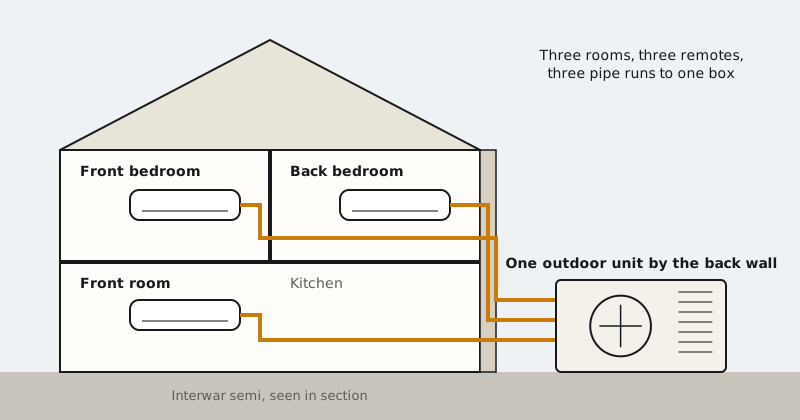
We measure the room and its windows, note the direction they face, check what lies overhead and next door, and ask who uses the room and at what times. Where more than one room is involved, each gets its own figure and its own indoor unit, and they can share one outdoor unit on a multi-split, as in the drawing. The size and the reasoning behind it go in your quote; what else happens on a survey visit is described on our Ilford air conditioning homepage.
Common questions
Can one large unit cool a whole flat?
Only if the flat is effectively one open space. Cooled air does not travel well through doorways and along halls, so separate rooms are better served by separate indoor units on one outdoor unit.
Is a 9,000 BTU unit enough for my bedroom?
Glow Green's table matches 9,000 BTU to rooms from 14 up to 23 square metres, about 2.6 kW on our conversion, which is at or above iHeat's figure for the same room. For a bedroom with ordinary windows it is generally enough; for a south-facing loft bedroom, check it at the survey.
Should the size suit heating or cooling?
Whichever is the harder job in that room. In a sunny loft that is often cooling; in a north-facing room relied on for winter warmth, heating may set the size.
Sources for this page
- iHeat: matching cooling output to a room (May 2026)
- Glow Green: BTU figures by room size
- Server Room Environments: working out the cooling a server room needs
- Mitsubishi Electric: data sheet for the MSZ-LN25VG2 and MUZ-LN25VG2 split, with power input, sound levels and refrigerant (June 2024, in French)
- Daikin: FTXM-R and RXM-R data sheet with sound levels and seasonal ratings (2021, published by the retailer Evomart)
- Fujitsu: specification for the ASYG KMCC wall units, with power input, seasonal ratings and indoor sound levels
- Met Office: Greenwich climate averages, 1991 to 2020
Five things to have handy
Answers to these let us judge, before anyone visits, how involved the job will be.
- Your postcode
- The building: terrace, semi, detached, a flat in a block or over a shop, or business premises
- Whether you own it outright, hold a lease or rent it
- Which room it is, its rough size, and whether it gets the morning or the afternoon sun
- Anything that limits outside changes: a conservation area, a listing, a lease clause or a managing agent
Want to talk about your own home or premises? Our page on air conditioning in Ilford sets out what we fit, how we look after it and where we work.
Services related to this guide
Air conditioning installation
Planned from survey to switch-on: a wall-mounted split, with the route, the wiring, the consents and the neighbours' window worked out before we drill.
Home air conditioning
For the bedroom that is still warm at midnight, the top-floor flat and the loft room: quiet indoor units that heat the same space in winter.
Multi-split air conditioning
One outdoor box running the bedrooms and the front room at once, each room set to its own temperature by its own remote.
More guides
Air conditioning costs: fitting, wiring and the bills that follow
National figures for the unit, the labour and the wiring, then the extras a lease, a landlord or a conservation area can bring.
What air conditioning costs to run, worked out at today's price cap
Pence per hour and pounds per summer for a 2.5 kW split, with winter warmth set against a fan heater and mains gas.
Does air conditioning need planning permission? The rules and the exceptions
When a unit counts as permitted development, and where Redbridge, Havering, Waltham Forest, Hackney and Chigwell differ.
No outdoor unit? Monoblocs, portables and splits compared
Through-wall monoblocs set against portables and splits, for flats and frontages that cannot carry an outdoor box.
How loud is air conditioning? Indoor units, outdoor units and the neighbours
Makers' decibel figures, the 37 dB(A) sum at the neighbour's window, and what happens if someone complains.
Cooling a bedroom: sleep, quiet running and the right size of unit
Why bedrooms are the first room to cool, how quiet a unit runs on its lowest setting, and how big it needs to be.
Air conditioning in a loft conversion: heat, siting and pipe routes
The research on hot London lofts, what to try first, and how a unit and its pipes fit a dormer or a gable.
Checking the F-gas register before you hire an air conditioning firm
The firm's certificate, the engineer's own qualification, how to check both, and where R32 sits in the leak-check rules.
Rather we called you?
Your name, phone number and postcode are all we need to call you. A word about the room helps us come prepared. You can also call 020 8176 6154.