Facts and figures last checked on 9 November 2026
Does air conditioning need planning permission? The rules and the exceptions
Most reversible splits on a house in England need no planning application, provided every permitted development condition is met. That changes for a cooling-only unit, a block with a shop in it, a listed home, a conservation area frontage or an Article 4 area. Below: the national rules, then the local ones around Ilford.
Ask us for a price
Leave three details and we phone you to talk it through.
When is an air conditioning unit permitted development?
When it is an air source heat pump that meets every condition on the Planning Portal's list. If you can answer yes to all of these, no application is needed:
- Will it provide warmth in winter too, rather than cooling alone?
- Is it installed to MCS 020a, including its noise calculation? MCS 020a has been the only certification route since 28 May 2026.
- Is the outdoor unit 1.5 cubic metres or smaller on a house, or 0.6 cubic metres or smaller on a block of flats?
- Is it the first outdoor unit on the property? A semi, a terrace or a block of flats is allowed one; a detached house is allowed two.
- If it serves a block, is the building made up entirely of flats, with no commercial premises in it?
- Is it off any pitched roof, and, on a flat roof, set back a metre or more from every edge?
- If it goes on a wall facing a road, is it at ground-floor level?
- Has it been placed, as far as practicable, to limit its effect on how the building looks?
Two further conditions stay with it: once microgeneration no longer needs it, it has to be removed as soon as is reasonably practicable, and the rights themselves can be removed by a planning condition or an Article 4 direction. Source: Planning Portal.
Why does a cooling-only unit need an application?
Because the right exists for heat pumps. SI 2025/560, in force since 29 May 2025, made it a condition that the heat pump is not used only for cooling. The same order let a house take a bigger outdoor unit (now 1.5 cubic metres at most; it had been 0.6), gave detached houses a second unit and dropped the old requirement to keep a metre from the boundary. Baxi's summary of the change says plainly that air-to-air heat pumps can now benefit. A reversible split qualifies; a model that only cools does not, however small. Check that the model on your quote heats as well. Sources: SI 2025/560; Baxi.
What is the 37 dB(A) noise test?
A calculation done before fitting, not a reading taken afterwards. The installer predicts how loud the outdoor unit will be 1 metre in front of the centre of the nearest window or door to a habitable room next door, starting from the sound power on the unit's energy label and allowing for distance, nearby hard surfaces and any solid barrier. At 37 dB(A) or below, the condition is met; above it, an application is needed. The noise guide goes through the steps. Sources: Grant UK; IOA and CIEH.
What extra limits apply in a conservation area?
The front of the house is ruled out. Inside one, an outdoor unit is barred from every wall and roof facing onto a highway, and from any spot closer to a bounding highway than the house is. (Outside conservation areas a road-facing wall can still take one at ground-floor level.) Redbridge has 16 conservation areas, from Valentines Mansion, designated in 1981 on the edge of central Ilford, to the Woodford, Wanstead and Snaresbrook groups covered on the Woodford page. In the Bungalow Estate, south of Seven Kings between Ilford and Goodmayes, designated as Mayfield on 3 October 1991, an Article 4 direction has controlled extensions, porches and roof alterations since September 1987, and the council lists a further direction for the estate from 2017, so we confirm the current controls with Redbridge's planners before quoting there.
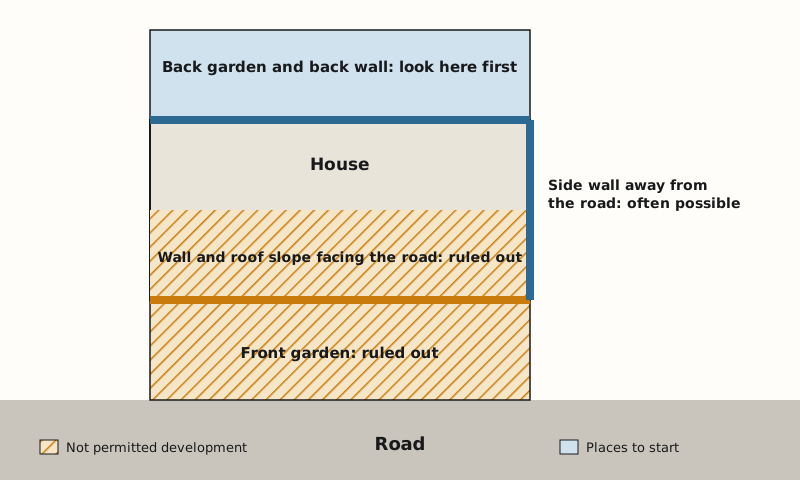
Sources: Planning Portal; Redbridge Council; Redbridge conservation area proposals; Bungalow Estate appraisal.
How does an Article 4 direction change things?
It switches off specific permitted development rights across a mapped area, so jobs that would otherwise be allowed need an application, and each direction names different classes. Gidea Park's, in force since 31 December 2015 and confirmed in June 2016, covers the houses in its conservation area at two levels. Level 1 controls extensions, alterations and roof changes at the front and sides; Level 2, the stronger, carries those controls round to the rear and adds porches, boundary walls and gates, and even painting the outside. The direction does not name heat pumps, but Havering's 2025 management plan for Gidea Park (in the February 2025 draft, adopted that September) asks for new external devices to be kept to rear elevations. Across the Essex border the picture is lighter: Epping Forest's list of directions includes none in Chigwell or Grange Hill, although Chigwell Village, designated on 2 October 1969, is still a conservation area. See the Gidea Park and Chigwell pages. Sources: Havering Council, Article 4; Gidea Park management plan; Havering consultation hub; Epping Forest District Council; planning.data.gov.uk.
Do Waltham Forest and Hackney take a different line?
Yes: both councils lean away from air conditioning in their guidance. Waltham Forest's Residential Alterations and Retrofit guidance, adopted on 11 June 2026, says mechanical ventilation with heat recovery (MVHR) "is considered over air conditioning", wants air source heat pumps in rear gardens wherever possible, keeps them off pitched roofs and says a heat pump in a front garden in a conservation area always needs permission. In Hackney, the September 2025 draft of the extensions and alterations guidance said residential air conditioning units are "typically not acceptable" and sent readers to the retrofit guidance for cooling; the extensions and alterations guidance was adopted in December 2025 and took effect in January 2026, so check the adopted wording before relying on the draft. Across London, policy SI 4 of the London Plan asks major developments to work down a cooling hierarchy in which active cooling comes last. The Walthamstow and Hackney pages give the local detail. Sources: Waltham Forest Council, adoption; Waltham Forest Council, heating and cooling; Hackney Council draft; Hackney Council, adoption; London Plan.
What about flats?
A block gets one outdoor unit under permitted development, of no more than 0.6 cubic metres, and only where the building is entirely flats; a flat above a shop needs an application. Planning is only one gate, because the freeholder's consent under the lease is a separate matter, and in Ilford it is a common one: 55% of households in Ilford Town ward live in flats. If the block's one unit is already taken or the freeholder refuses, a through-wall monobloc may still be possible. Sources: Planning Portal; LEASE; Area Insights.
Do listed buildings, shops and offices need an application?
Both usually mean an application. Permitted development does not apply within the curtilage of a listed building, any work affecting its character needs listed building consent, and carrying such work out without consent is a criminal offence. Historic England's 2023 draft advice suggested heat pumps would generally be acceptable at listed buildings if sympathetically sited; that describes a likely outcome, not an exemption from consent. On shops, offices and other buildings that are not homes, the Planning Portal expects an application to be needed in most cases, and Mishcon de Reya notes that an unauthorised unit can attract an enforcement notice, typically requiring it to be moved or removed. Our Ilford air conditioning homepage sets out the wider local picture. Sources: Planning Portal; section 7; section 9; The Construction Index; Planning Portal; Mishcon de Reya.
Common questions
Can a semi have two outdoor units without an application?
No: a semi or a terrace is allowed one. A multi-split runs several rooms from that single unit, or a second unit can go in with planning permission.
Does my neighbour have to agree?
Not under permitted development, but the noise test is calculated at their nearest window, and noise that amounts to a statutory nuisance can still be acted on later. The noise guide explains both.
Who checks whether my home qualifies?
We do, at the survey: the conditions, the conservation area and Article 4 position, and the noise sum. You hear whether an application or consent is needed before any work is booked.
Sources for this page
- Planning Portal: permitted development for an air source heat pump on a house or a block of flats
- legislation.gov.uk: SI 2025/560, the May 2025 change to permitted development
- Baxi: the heat pump permitted development changes of 29 May 2025, explained
- Grant UK: heat pumps and planning in England, including the 37 dB(A) limit (May 2025)
- Institute of Acoustics and CIEH: professional advice note on noise from domestic air source heat pumps (2026)
- Redbridge Council: listed buildings, conservation areas and Article 4 directions
- Redbridge Council: management proposals for every conservation area, with designation years (2014)
- Redbridge Council: the Bungalow Estate conservation area appraisal (2014)
- Havering Council: the Gidea Park Article 4 direction (31 December 2015)
- Havering Council: Gidea Park conservation area appraisal and management plan (draft, February 2025; adopted September 2025)
- Havering Council: new appraisals for Romford, Rainham and Gidea Park, adopted 17 September 2025
- Epping Forest District Council: Article 4 directions in the district
- planning.data.gov.uk: Chigwell Village conservation area
- Waltham Forest Council: Residential Alterations and Retrofit guidance, adopted 11 June 2026
- Waltham Forest Council: heating and cooling in the Residential Alterations and Retrofit guidance
- Hackney Council: draft guidance on residential extensions and alterations (September 2025)
- Hackney Council: the extensions and alterations guidance, adopted December 2025
- Greater London Authority: the London Plan 2021, including policy SI 4 on heat risk
- LEASE: asking the freeholder before altering a leasehold flat
- Area Insights: Ilford Town ward, Census 2021
- legislation.gov.uk: when listed building consent is required (1990 Act, s.7)
- legislation.gov.uk: the offence of altering a listed building without consent (1990 Act, s.9)
- The Construction Index: Historic England's 2023 draft advice on heat pumps at listed buildings
- Planning Portal: heat pumps on shops, offices and other non-domestic buildings
- Mishcon de Reya: legal points to settle before fitting air conditioning (8 July 2026)
Five things to have handy
Answers to these let us judge, before anyone visits, how involved the job will be.
- Your postcode
- The building: terrace, semi, detached, a flat in a block or over a shop, or business premises
- Whether you own it outright, hold a lease or rent it
- Which room it is, its rough size, and whether it gets the morning or the afternoon sun
- Anything that limits outside changes: a conservation area, a listing, a lease clause or a managing agent
Want to talk about your own home or premises? Our page on air conditioning in Ilford sets out what we fit, how we look after it and where we work.
Services related to this guide
Air-to-air heat pumps
A reversible split chosen as a room's main heater, delivering several kilowatt-hours of warmth for every one it uses, with summer cooling included.
Air conditioning installation
Planned from survey to switch-on: a wall-mounted split, with the route, the wiring, the consents and the neighbours' window worked out before we drill.
Commercial air conditioning
Cooling for the shop floor, the salon chair and the kitchen pass, sized for a door that never stays shut and placed with the flats upstairs in mind.
More guides
Air conditioning costs: fitting, wiring and the bills that follow
National figures for the unit, the labour and the wiring, then the extras a lease, a landlord or a conservation area can bring.
What air conditioning costs to run, worked out at today's price cap
Pence per hour and pounds per summer for a 2.5 kW split, with winter warmth set against a fan heater and mains gas.
No outdoor unit? Monoblocs, portables and splits compared
Through-wall monoblocs set against portables and splits, for flats and frontages that cannot carry an outdoor box.
How loud is air conditioning? Indoor units, outdoor units and the neighbours
Makers' decibel figures, the 37 dB(A) sum at the neighbour's window, and what happens if someone complains.
Cooling a bedroom: sleep, quiet running and the right size of unit
Why bedrooms are the first room to cool, how quiet a unit runs on its lowest setting, and how big it needs to be.
Air conditioning in a loft conversion: heat, siting and pipe routes
The research on hot London lofts, what to try first, and how a unit and its pipes fit a dormer or a gable.
Sizing an air conditioner: kilowatts, BTU and the room in front of you
Two published sizing tables side by side, the conversion between them, and what changes the answer.
Checking the F-gas register before you hire an air conditioning firm
The firm's certificate, the engineer's own qualification, how to check both, and where R32 sits in the leak-check rules.
Rather we called you?
Your name, phone number and postcode are all we need to call you. A word about the room helps us come prepared. You can also call 020 8176 6154.