Facts and figures last checked on 9 November 2026
What air conditioning costs to run, worked out at today's price cap
A modern 2.5 kW split costs pennies an hour to run. Using Ofgem's price cap for the last quarter of 2026 and published data sheets, we work out the hourly cost, a summer of cooling and the price of winter warmth in Ilford. Every figure below is our own sum, and the cap changes again in January.
Ask us for a price
Leave three details and we phone you to talk it through.
How many pence does an hour of cooling use?
About 11p to 17p for a 2.5 kW split running flat out, on our sums: each unit's rated power input multiplied by the cap rate of 26.32p per kWh.
| Unit | Cooling output | Rated power input | Our cost per hour at full output |
|---|---|---|---|
| Mitsubishi Electric MSZ-LN25VG2 | 2.5 kW | 0.485 kW | about 12.8p |
| Fujitsu ASYG09KMCC | 2.5 kW | 0.630 kW | about 16.6p |
Rated figures are taken at test conditions; the Energy Saving Trust's slides quote a COP of 6.2 for a 2.6 kW unit at 35°C outdoors and 27°C indoors, without saying which figure is input and which output. On an ordinary warm day the same unit, once the room is down to temperature, slows its compressor and draws less. Checkatrade's broad national guide is 20p to 60p an hour; a small modern unit comes in below the bottom of that range on our figures. Sources: Ofgem; Mitsubishi Electric; Fujitsu; Energy Saving Trust slides; Checkatrade.
What do SEER and SCOP mean, and what do the label classes stand for?
They are season-long efficiency ratings. Under the energy labelling regulation as it applies in Great Britain, SEER is the cooling delivered over a whole cooling season divided by the electricity used for it, and SCOP is the same for heating over the heating season. A SEER of 7 means seven units of cooling for every unit of electricity, averaged over the season rather than measured on one hot afternoon. For air conditioners other than single- and double-duct units, which the regulation rates on a separate scale, the top label classes begin at:
| Label class | Cooling (SEER) | Heating (SCOP) |
|---|---|---|
| A+++ | 8.50 and above | 5.10 and above |
| A++ | 6.10 up to 8.50 | 4.60 up to 5.10 |
| A+ | 5.60 up to 6.10 | 4.00 up to 4.60 |
| A | 5.10 up to 5.60 | 3.40 up to 4.00 |
The three 2.5 kW models we compare across these guides span the top of that scale. Mitsubishi's MSZ-LN25VG2 is A+++ both ways (SEER 10.5, SCOP 5.2), Daikin's FTXM25R is A+++ both ways (SEER 8.65, SCOP 5.10), and Fujitsu's ASYG09KMCC is A++ for cooling and A+ for heating (SEER 7.4, SCOP 4.1). For comparison, the Energy Saving Trust's slides call a SEER of about 7 and a SCOP above 4 typical for air-to-air units. Sources: Regulation 626/2011; Mitsubishi Electric; Daikin; Fujitsu; Energy Saving Trust slides.
What would a summer of cooling cost?
Somewhere around £22 to £31 for a 2.5 kW split, on our sums. The energy label assumes 350 hours of cooling a year. If a 2.5 kW unit delivered its full output for all 350 hours, that would be 875 kWh of cooling; divide by the unit's SEER and multiply by 26.32p:
- SEER 10.5 (the Mitsubishi): about 83 kWh of electricity, about £21.90
- SEER 8.65 (the Daikin): about 101 kWh, about £26.60
- SEER 7.4 (the Fujitsu): about 118 kWh, about £31.10
So in cooling, the difference between the most and least efficient of the three is worth about £9 over a label season. Treat the 350 hours as the label's assumption, not a forecast: the Energy Saving Trust says there isn't much data on how air-to-air systems perform in UK homes, and a bedroom cooled only on hot nights might use far fewer hours than a sunny office. Sources: Regulation 626/2011, Annex VII; Mitsubishi Electric; Daikin; Fujitsu; Ofgem; Energy Saving Trust advice.
How does it compare with a fan heater or gas for warmth?
Per unit of heat, a split run as a heat pump costs between a quarter and a fifth of what a plug-in heater does, and on its seasonal rating it also undercuts gas burned in a boiler. Our sums for 1,000 kWh of warmth delivered to a room, at the cap in force until 31 December 2026:
| Heat source | Energy bought | Our cost |
|---|---|---|
| Fan heater or oil-filled radiator, which turns each unit of electricity into one unit of heat | 1,000 kWh of electricity | £263.20 |
| Split at SCOP 4.1 (the Fujitsu) | about 244 kWh of electricity | about £64.20 |
| Split at SCOP 5.2 (the Mitsubishi) | about 192 kWh of electricity | about £50.60 |
| Mains gas (7.97p a kWh at the cap) | 1,000 kWh of gas, before the boiler's own losses | £79.70, plus whatever the boiler wastes |
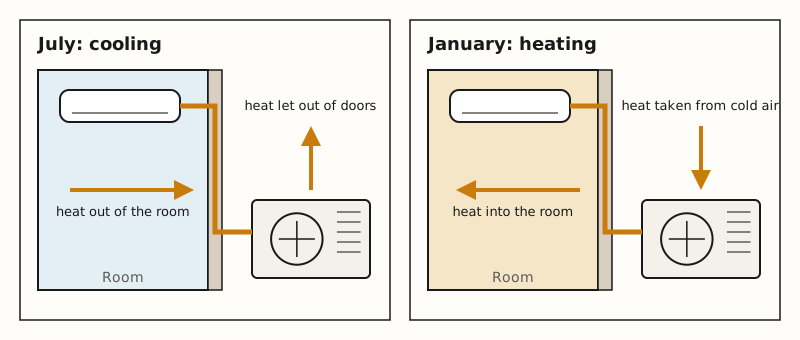
Two caveats keep this fair. SCOP is a seasonal average for the label's standard climate, and the Energy Saving Trust notes how little UK data there is, so real results may fall short of it. And a boiler also heats your hot water, a job air-to-air units do not do, so in a gas-heated home a split usually works alongside the boiler rather than replacing it. Sources: Ofgem; Mitsubishi Electric; Fujitsu; Energy Saving Trust advice.
Does the standing charge count against the air conditioning?
No. The electricity standing charge, 54.83p a day under the current cap, is paid whether the unit runs or not, so it belongs to the house rather than the appliance; only the unit rate rises with use. Standby is small as well. The Energy Saving Trust's slides give a Bosch single split's standby draw as under 1 watt, which on our sum comes to under 9 kWh, or less than £2.40, across a whole year. Sources: Ofgem; Energy Saving Trust slides.
Will these figures change in January?
Almost certainly. Ofgem resets the cap every quarter, and the rates for January to March 2027 are due to be announced on 25 November 2026 (Ofgem, August 2026). The 26.32p rate also assumes no VAT on electricity, which holds from 1 October 2026 to 31 March 2027. Every sum on this page moves in step with the unit rate, so a cap a tenth higher makes each running cost a tenth higher. Your own tariff may sit above or below the cap. Source: Ofgem.
How do you keep the running cost down?
Start with the room, then the settings. The Energy Saving Trust suggests shading windows and improving ventilation before reaching for cooling at all. After that: keep the door of the cooled room shut, pick a moderate set temperature rather than the lowest the remote offers, and make sure the unit is matched to the room, which the sizing guide explains. The services we offer are summarised on our Ilford air conditioning homepage. Source: Energy Saving Trust advice.
Common questions
Does a higher label class pay for itself?
In cooling alone, rarely: on our sums the gap between SEER 7.4 and SEER 10.5 is about £9 over the label's 350-hour season. The label assumes four times as many hours of heating, 1,400, so if the unit will warm the room through winter the better SCOP matters more. Weigh noise, size and heating use as well.
Are these your prices?
No. They are our arithmetic from Ofgem's cap and manufacturers' published data, to show the scale of the bill. Fitting costs are in the cost guide.
Is heating with a split cheaper than gas?
On seasonal ratings, per unit of heat, yes: about 5p to 6.4p against at least 7.97p for gas before boiler losses, on our sums. It does not heat hot water, though, so most gas homes keep the boiler.
Sources for this page
- Ofgem: changes to the price cap from 1 October 2026, with the date of the next announcement (26 August 2026)
- Ofgem: capped unit rates and standing charges for October to December 2026
- Mitsubishi Electric: data sheet for the MSZ-LN25VG2 and MUZ-LN25VG2 split, with power input, sound levels and refrigerant (June 2024, in French)
- Fujitsu: specification for the ASYG KMCC wall units, with power input, seasonal ratings and indoor sound levels
- Daikin: FTXM-R and RXM-R data sheet with sound levels and seasonal ratings (2021, published by the retailer Evomart)
- Energy Saving Trust: air-to-air heat pumps, webinar slides (2024)
- Checkatrade: national figures for fitting air conditioning (May 2026)
- legislation.gov.uk: Regulation 626/2011 on air conditioner energy labels, with the SEER and SCOP classes
- legislation.gov.uk: Regulation 626/2011, Annex VII, the yearly hours of use the label assumes
- Energy Saving Trust: air-to-air heat pump advice, with installed costs (updated 20 October 2026)
Five things to have handy
Answers to these let us judge, before anyone visits, how involved the job will be.
- Your postcode
- The building: terrace, semi, detached, a flat in a block or over a shop, or business premises
- Whether you own it outright, hold a lease or rent it
- Which room it is, its rough size, and whether it gets the morning or the afternoon sun
- Anything that limits outside changes: a conservation area, a listing, a lease clause or a managing agent
Want to talk about your own home or premises? Our page on air conditioning in Ilford sets out what we fit, how we look after it and where we work.
Services related to this guide
Air-to-air heat pumps
A reversible split chosen as a room's main heater, delivering several kilowatt-hours of warmth for every one it uses, with summer cooling included.
Home air conditioning
For the bedroom that is still warm at midnight, the top-floor flat and the loft room: quiet indoor units that heat the same space in winter.
Air conditioning servicing
Filters, coils and drain cleaned and the system measured against its rating, on any make, with the legal leak check added only where the charge requires it.
More guides
Air conditioning costs: fitting, wiring and the bills that follow
National figures for the unit, the labour and the wiring, then the extras a lease, a landlord or a conservation area can bring.
Does air conditioning need planning permission? The rules and the exceptions
When a unit counts as permitted development, and where Redbridge, Havering, Waltham Forest, Hackney and Chigwell differ.
No outdoor unit? Monoblocs, portables and splits compared
Through-wall monoblocs set against portables and splits, for flats and frontages that cannot carry an outdoor box.
How loud is air conditioning? Indoor units, outdoor units and the neighbours
Makers' decibel figures, the 37 dB(A) sum at the neighbour's window, and what happens if someone complains.
Cooling a bedroom: sleep, quiet running and the right size of unit
Why bedrooms are the first room to cool, how quiet a unit runs on its lowest setting, and how big it needs to be.
Air conditioning in a loft conversion: heat, siting and pipe routes
The research on hot London lofts, what to try first, and how a unit and its pipes fit a dormer or a gable.
Sizing an air conditioner: kilowatts, BTU and the room in front of you
Two published sizing tables side by side, the conversion between them, and what changes the answer.
Checking the F-gas register before you hire an air conditioning firm
The firm's certificate, the engineer's own qualification, how to check both, and where R32 sits in the leak-check rules.
Rather we called you?
Your name, phone number and postcode are all we need to call you. A word about the room helps us come prepared. You can also call 020 8176 6154.