Ilford air conditioning that cools in July and heats in January
Air conditioning fitted, looked after and mended across Ilford and the IG postcodes, from the back bedroom of an Edwardian terrace to a flat in the new blocks by the station or a salon on the High Road. The systems we fit run in reverse to heat as well. Leave a postcode and we call you back.
Ask us for a price
Leave three details and we phone you to talk it through.
- We survey before we price
- We find out who owns the wall first
- One unit for summer and winter
What does a year of weather ask of an air conditioner here?
Twelve frames, one for each month, each exposed to the average daytime high at Greenwich, about six miles away and the nearest Met Office station we found with published long-term averages. Amber frames mark the months a reversible unit spends mostly cooling, blue the months it spends mostly heating, and silver the two months in between.
- January: typical daytime top of 8C, a month for heating.
- February: typical daytime top of 9C, a month for heating.
- March: typical daytime top of 12C, a month for heating.
- April: typical daytime top of 15C, a month for heating.
- May: typical daytime top of 19C, neither mostly heating nor mostly cooling.
- June: typical daytime top of 21C, a month for cooling.
- July: typical daytime top of 24C, a month for cooling.
- August: typical daytime top of 23C, a month for cooling.
- September: typical daytime top of 20C, neither mostly heating nor mostly cooling.
- October: typical daytime top of 16C, a month for heating.
- November: typical daytime top of 12C, a month for heating.
- December: typical daytime top of 9C, a month for heating.
Average daily maximum, °C, for 1991 to 2020. Ilford has no Met Office station of its own; Greenwich, about six miles away on the other side of the Thames, is the nearest station we found with a published set of long-term averages. Its averages give a July high of 23.75°C, around 23 days of air frost and about 563 mm of rain. Source: Met Office.
What kind of house is a typical Ilford home?
Very often a terrace more than a hundred years old. Ilford had 10,913 residents in 1891 and 78,188 in 1911, and between 1901 and 1911 Southend was the only English town of over 50,000 people that grew faster. Cameron Corbett began the Grange estate north of the station in 1894 and the Downshall and Mayfield estates at Seven Kings and Goodmayes in 1898, while Peter Griggs built the Cranbrook estate from 1897. Most of what they put up was long, regular streets of two-storey terraces on narrow plots. At the 2021 Census terraced houses were still the most common home in Redbridge: 33,469 of the borough's 103,713 households, or 32.3%, against 27.0% in semi-detached houses and 25.4% in purpose-built flats.
That makes a lot of Ilford straightforward to cool. The back bedroom usually takes the afternoon sun and sits a short pipe run from a rear wall, a side return or the flat roof of a back addition. Permitted development allows one outdoor unit on a terrace or semi and two on a detached house, provided the unit heats as well as cools, measures no more than 1.5 cubic metres, stays off pitched roofs, and goes no higher than the ground floor on any wall that faces a road.
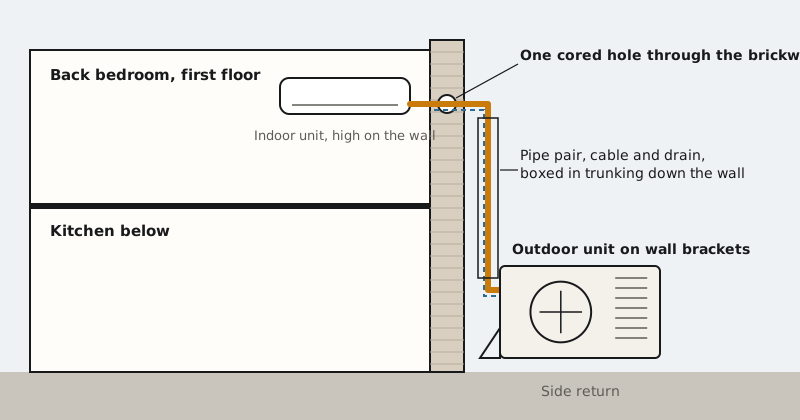
Sources: Victoria County History, population; Victoria County History, Ilford; Area Insights, Census 2021; Planning Portal.
What is changing around Ilford station?
The town centre is growing upwards. Shenfield line trains took the Elizabeth line name on 24 May 2022, the station gained a new entrance and step-free access to every platform that year, and from 6 November 2022 Shenfield trains ran through central London to Paddington. Redbridge's Local Plan, adopted on 15 March 2018, expects 5,300 new homes in the Ilford growth area and treats the town centre as a zone where tall buildings may go. Pioneer Point, 105 metres high, is already the tallest building in the borough. In December 2022 Chapel Place received consent for 837 homes in towers of up to 36 storeys, and in May 2025 a scheme of 326 social-rent flats, rising to 30 storeys, was approved on the former Harrison Gibson site on the High Road.
Flats like these are well sealed and well insulated, which holds the heat in once a warm spell sets in, and research for the government found that more than half of households sometimes report something stopping them opening their windows, mainly security or noise. Approved Document O, the overheating rule in the Building Regulations, has applied since 15 June 2022 and covers new residential buildings only; homes created by conversion are outside it, for now. In a block of flats, permitted development allows a single outdoor unit for the entire building, which leaves most decisions with whoever manages or owns the block. Where nothing may be fixed outside, a unit with no outdoor box is the usual answer. Sources: TfL; Network Rail; Network Rail on through trains; Redbridge Council; Local Plan policy LP1A; policy LP27; Londonist; Construction Enquirer; AHR; MHCLG; Planning Portal; Elmhurst Energy.
Who has to agree before an outdoor unit goes up?
In Ilford it is more often a landlord or a freeholder than the person living there. Private renting in Redbridge climbed from 22.9% of households in 2011 to just over 30% in 2021, and over the same decade the share of households owning their home fell from 63.6% to 57.1%, which the ONS records as the joint largest percentage-point fall in England. In Ilford Town ward the pattern is stronger still: 56% of households rent privately and 55% live in flats.
Renters should get the landlord's consent on paper first, since the work goes through an outside wall. A leaseholder needs the freeholder's, because the outside walls are normally the freeholder's to control. LEASE, the leasehold advice service, says that where work alters the freeholder's own structure, such as an outside wall, the freeholder does not have to agree, and may ask a premium of any amount as the price of agreeing. Landlords have rules of their own as well. Selective licensing covers Ilford Town and Valentines wards from 1 November 2023 to 31 October 2028 and fifteen more Redbridge wards from 8 April 2024 to 7 April 2029; additional licensing of smaller shared houses runs across the whole borough until 17 September 2028; and since 6 December 2019 turning a house into a small shared house for three to six people has needed planning permission. None of these rules stops a landlord fitting air conditioning, though the paperwork for the new electrical circuit should be kept with the property records. Sources: Redbridge Council, 2011 Census; Area Insights, Census 2021; ONS; Area Insights, Ilford Town ward; LEASE; LEASE on charges; Redbridge Council, Ilford Town and Valentines; fifteen-ward scheme; additional licensing; Article 4 on shared houses.
Which parts of Ilford come under conservation rules?
Only a small part, because most of Redbridge's 16 conservation areas are in Wanstead, Snaresbrook and Woodford. The two nearest the town centre are Valentines Mansion, designated in 1981, and the Bungalow Estate between Seven Kings and Goodmayes, first designated as Mayfield on 3 October 1991 and extended and renamed in 2014. William Henry Knox drew the first bungalow designs there in December 1919, John William Moore built from 1925, and the estate was largely finished by 1939; an Article 4 direction has controlled extensions, porches and roof alterations there since September 1987. Valentines Mansion itself is late 17th century and listed at Grade II*, its park is a registered park and garden at Grade II, and the chapel of Ilford Hospital, founded about 1145 by the Abbess of Barking, is also Grade II*.
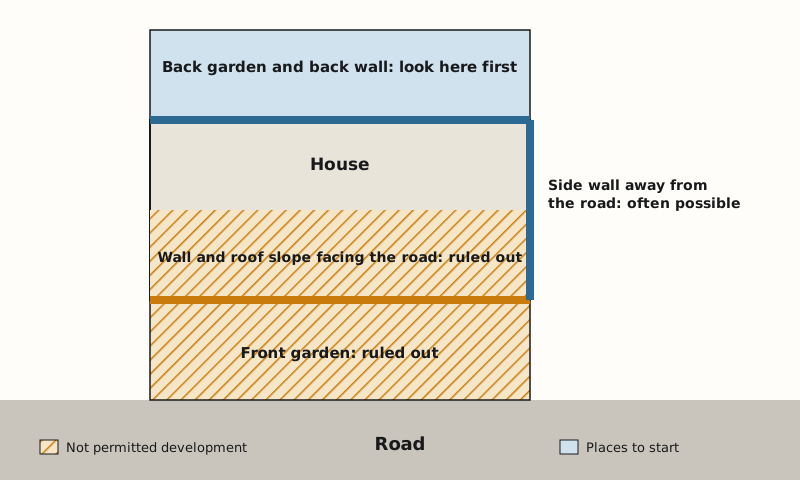
In a conservation area the householder allowance for outdoor units stops short of any wall or roof that fronts a road and out of the ground between the house and the road. At a listed building there is no permitted development at all, and changing the building's character without listed building consent is an offence. So in the Bungalow Estate we begin at the back garden, and anywhere near a listed building we begin with the council. Sources: Redbridge Council; conservation area proposals, 2014; Bungalow Estate appraisal; Historic England, Valentines Mansion; Historic England, Valentines Park; Historic England, Ilford Hospital chapel; Planning Portal; the 1990 Act, section 7; section 9.
In your home
Most people start with one room: a back bedroom over the kitchen in a Seven Kings terrace, a loft room in a Gants Hill semi, or a flat in one of the newer blocks near the station. Start with that room and add others later if you need to.
Air conditioning installation
Planned from survey to switch-on: a wall-mounted split, with the route, the wiring, the consents and the neighbours' window worked out before we drill.
Home air conditioning
For the bedroom that is still warm at midnight, the top-floor flat and the loft room: quiet indoor units that heat the same space in winter.
Air-to-air heat pumps
A reversible split chosen as a room's main heater, delivering several kilowatt-hours of warmth for every one it uses, with summer cooling included.
Multi-split air conditioning
One outdoor box running the bedrooms and the front room at once, each room set to its own temperature by its own remote.
Conservatory air conditioning
Glass rooms, garden offices and studios made usable from the summer glare to a January frost.
Where you work
For nearly a century Ilford's best-known employer made photographic plates and film in the middle of town. Workplaces now are smaller and more varied: High Road shops and salons, restaurants and takeaways, offices and clinics near the station, and the comms cupboard every one of them relies on.
Office air conditioning
Open-plan floors, meeting rooms and offices above shops, cooled to suit the headcount and the equipment.
Commercial air conditioning
Cooling for the shop floor, the salon chair and the kitchen pass, sized for a door that never stays shut and placed with the flats upstairs in mind.
Server room cooling
A dedicated unit for the comms cupboard or rack, on its own controls and running round the clock.
After it is fitted
If a system is already fitted, we look after it, whoever installed it. If you are still deciding, read what air conditioning costs to fit and what it costs to run first.
Air conditioning servicing
Filters, coils and drain cleaned and the system measured against its rating, on any make, with the legal leak check added only where the charge requires it.
Air conditioning repairs
No cooling, water on the floor, frosted pipes or a flashing code: the cause found first, then a price.
Will the same unit heat the room through the winter?
Yes, and for a fraction of the cost of a plug-in heater. Switched to heating, the box outside pulls warmth out of cold air and the wall unit passes it to the room. Air-to-air systems typically reach a seasonal heating efficiency above 4, according to the Energy Saving Trust, meaning each unit of electricity delivers about four units of heat. With electricity capped by Ofgem at 26.32p a kWh for October to December 2026, our own sum puts a kilowatt-hour of heat from such a system at about 6.6p, against the full 26.32p from a plug-in fan heater and 7.97p for gas before any boiler losses. Ofgem has said the cap for January 2027 onwards will be announced on 25 November.
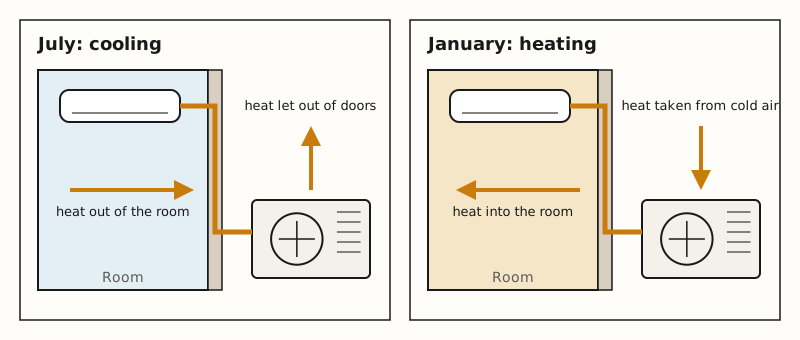
It warms the room it is fitted in, not the radiators or the hot water, so it works alongside a boiler rather than replacing one. The air-to-air heat pump page explains where that pays off, and the running costs guide sets out the sums. Sources: Energy Saving Trust; Ofgem; Ofgem, August 2026.
Can you cool shops, salons and offices on the High Road?
Yes, and Ilford has done industrial-scale temperature control before. Alfred Harman began making photographic plates in the town in 1879, his Britannia Works became Ilford Limited, and the firm stayed until 1976, when production moved to Basildon. A Sainsbury's opened on the Roden Street site in 1985, and the same land is where Chapel Place has been approved. The workplaces we cool are shops, salons, cafés and restaurants on the High Road, offices and clinics near the station, and the server cupboards in the back of all of them.
There is no legal maximum temperature for a workplace. The law says the temperature indoors must be reasonable, and since June 2026 the HSE has said heat should be assessed like any other hazard. On a shop or office, an outdoor unit is likely to need planning permission because the householder rules do not apply; on top of that, a building whose air conditioning adds up to more than 12 kW must have it inspected by an energy assessor at least every five years. See commercial air conditioning, office air conditioning and server room cooling. Sources: Wikipedia on Ilford Photo; Let's Talk Redbridge; HTA Design; legislation.gov.uk; HSE; Planning Portal; GOV.UK.
What should any installer be able to show you?
Proof of two separate registrations and a sound figure. First, the company's F-gas certificate: every business that installs or services refrigerant equipment for other people, sole traders included, must be certified by an approved body such as Refcom, the F-Gas Register or Bureau Veritas, and must renew every three years; the technician who handles the refrigerant also needs a personal qualification. Second, how the electrics will be signed off. A new circuit is notifiable under Part P; if the electrician belongs to a competent person scheme, the work can be self-certified and the certificate should reach you within eight weeks. Third, for a home, the result of the MCS 020a sound calculation, which has to come to 37 dB(A) or less at the neighbour's nearest window or door for the unit to count as permitted development. Our F-gas checking guide shows how to look a firm up. Sources: GOV.UK; GOV.UK; IET; GOV.UK; Grant UK.
Which towns around Ilford do we cover?
Ilford and the IG postcodes from IG1 to IG8, then west into Waltham Forest and Hackney, east through Havering and north to Chigwell. Each town page deals with that place as it is: the houses it was built with, the conservation areas and Article 4 directions its council has made, and the landlord rules that apply there.
Air conditioning in Woodford
Air conditioning in Chigwell
Air conditioning in Romford
Air conditioning in Gidea Park
Air conditioning in Hornchurch
Air conditioning in Upminster
Air conditioning in Walthamstow
Air conditioning in Chingford
Air conditioning in Hackney
Other places we reach
- Ilford town centre, Cranbrook and Loxford (IG1)
- Gants Hill, Newbury Park and Aldborough Hatch (IG2)
- Seven Kings and Goodmayes (IG3)
- Redbridge and Clayhall (IG4, IG5)
- Barkingside, Fairlop and Hainault (IG6)
- Wanstead and Snaresbrook (E11)
- Collier Row, Harold Hill and Harold Wood (RM3, RM5)
- Barking and Dagenham (IG11, RM8, RM9, RM10)
- Leyton and Leytonstone (E10, E11)
- Stratford, Forest Gate, Manor Park and East Ham (E15, E7, E12, E6)
What happens after you get in touch?
A short call about the building
Phone 020 8176 6154 or send the form. We ask what kind of property it is, which rooms you want cooler or warmer, and whether you own the wall the pipes would pass through, so the visit covers what matters.
A visit, measurements and a written quote
At the property we size the room, find a spot for the outdoor unit, work out the sound level at the closest neighbouring window and check that the fuse board can take a new circuit. The quote follows on paper, with the electrical work and any access equipment on separate lines.
Agreement before anything is ordered
If a freeholder, landlord, managing agent or the council must approve the work, nothing is bought until they do. We supply the plan and noise figure they normally want to see.
Fitting day and handover
We fix both units, run the pipes, drain and cable, pressure-test the pipework and pull a vacuum on it before any refrigerant goes in, then check the system in cooling and in heating. We go through the controls with you and leave the paperwork. A yearly service keeps it efficient.
Worth reading before you collect quotes
Air conditioning costs: fitting, wiring and the bills that follow
National figures for the unit, the labour and the wiring, then the extras a lease, a landlord or a conservation area can bring.
What air conditioning costs to run, worked out at today's price cap
Pence per hour and pounds per summer for a 2.5 kW split, with winter warmth set against a fan heater and mains gas.
Does air conditioning need planning permission? The rules and the exceptions
When a unit counts as permitted development, and where Redbridge, Havering, Waltham Forest, Hackney and Chigwell differ.
No outdoor unit? Monoblocs, portables and splits compared
Through-wall monoblocs set against portables and splits, for flats and frontages that cannot carry an outdoor box.
How loud is air conditioning? Indoor units, outdoor units and the neighbours
Makers' decibel figures, the 37 dB(A) sum at the neighbour's window, and what happens if someone complains.
Cooling a bedroom: sleep, quiet running and the right size of unit
Why bedrooms are the first room to cool, how quiet a unit runs on its lowest setting, and how big it needs to be.
Air conditioning in a loft conversion: heat, siting and pipe routes
The research on hot London lofts, what to try first, and how a unit and its pipes fit a dormer or a gable.
Sizing an air conditioner: kilowatts, BTU and the room in front of you
Two published sizing tables side by side, the conversion between them, and what changes the answer.
Checking the F-gas register before you hire an air conditioning firm
The firm's certificate, the engineer's own qualification, how to check both, and where R32 sits in the leak-check rules.
Questions we get asked in Ilford
What does a single wall unit cost to fit in Ilford?
We price after a survey, not on the phone. For a national comparison, Checkatrade's May 2026 table lists a 12,000 BTU wall unit at £750 and fitting it at £1,150; our own addition of those comes to about £1,900, and Checkatrade adds £400 to £700 for the electrics. The cost guide explains what moves the figure.
Our flat is in one of the new towers. Can we still have air conditioning?
Often, but the freeholder or managing agent decides, and a block only gets one outdoor unit under permitted development. If the block already has one, or the lease forbids anything outside, a through-wall unit with no outdoor box may be the way to go.
Can it replace our heating in winter?
It can heat the room it is in, efficiently, but it does not run radiators or make hot water. It is usually run alongside the boiler, for the rooms that are hardest to keep comfortable.
How loud will it be for next door?
For a home to qualify as permitted development, the calculated sound at the neighbour's nearest window or door must be 37 dB(A) or below. We work that figure out before we quote and tell you what it is. The noise guide explains how it is calculated.
We rent. Can we arrange it ourselves?
Not without your landlord's written agreement, because the work goes through an outside wall and adds a circuit. If your landlord agrees, we can deal with them directly about access and the paperwork.
Which areas do you cover?
Ilford and every IG postcode from IG1 to IG8, Romford, Gidea Park, Hornchurch and Upminster, Woodford and Chigwell, Walthamstow, Chingford and Hackney, and the places in between. The areas page lists them all with their councils.
Rather we called you?
Your name, phone number and postcode are all we need to call you. A word about the room helps us come prepared. You can also call 020 8176 6154.