Facts and figures last checked on 9 November 2026
How loud is air conditioning? Indoor units, outdoor units and the neighbours
A modern split is quiet indoors and moderately quiet outdoors, and planning rules put a number on it: 37 dB(A) at the neighbour's window. This guide gives the makers' figures, explains how that number is calculated, what Redbridge does with a noise complaint, and the practical ways to keep an outdoor unit in Ilford quieter.
Ask us for a price
Leave three details and we phone you to talk it through.
How loud is the indoor unit?
Around 19 to 20 dB(A) on its quietest setting and 40 to 42 dB(A) at full fan speed, on the makers' sound pressure figures for three current 2.5 kW models:
| Indoor unit | Quietest setting | Full fan speed |
|---|---|---|
| Mitsubishi Electric MSZ-LN25VG2 | 19 dB(A) | 42 dB(A) |
| Daikin FTXM25R | 19 dB(A) | 41 dB(A) |
| Fujitsu ASYG09KMCC | 20 dB(A) | 40 dB(A) |
Which end of that range you hear depends mostly on sizing. A unit big enough for the room can hold it on a low fan speed; one that is too small spends hot evenings near the top. When comparing models, ask for both figures, the lowest setting and full speed, rather than a single headline number. The bedroom guide covers sizing for a quiet night. Sources: Mitsubishi Electric; Daikin; Fujitsu.
How loud is the outdoor unit?
About 46 dB(A) at 1 metre in cooling for a 2.5 kW outdoor unit. That is the figure on both Mitsubishi's MUZ-LN25VG2 and Daikin's RXM25R9, and Daikin's rises to 47 dB(A) in heating. Those are sound pressure figures: what you would hear a metre away. The planning test starts from a different number, sound power, which describes the total sound the unit gives off wherever you stand; Daikin gives 58 dB(A) for that outdoor unit. Sound pressure falls as you move away, while sound power stays the same. Sources: Mitsubishi Electric; Daikin; IOA and CIEH.
How does the 37 dB(A) planning test work?
It is a sum the installer does before fitting, under MCS 020a, and permitted development depends on the answer (the planning guide lists the other conditions). The answer has to come out at 37 dB(A) or below at the assessment point, which is 1 metre in front of the centre of the nearest window or door to a habitable room in the neighbouring property, leaving out reflections from that wall. The steps:
- Take the outdoor unit's sound power from its energy label or data sheet. A figure for any low-noise mode may not be used.
- Count the hard surfaces within a metre of the unit, the ground included. Each extra surface, up to three, pushes the result up; more than three, as in a narrow lightwell, fails outright.
- Measure the distance to the assessment point and take off the reduction for that distance.
- Allow for a barrier: 10 dB off if a solid barrier completely hides the assessment point from the top edge of the unit, 5 dB if it is hidden but moving 25 cm would reveal it, nothing if any part of it is in view.
A council form written for the original MCS 020 sets these steps out; MCS 020a removes that form's later steps and clarifies the rules on barriers, hard surfaces and the assessment point. Sources: Grant UK; IOA and CIEH; Copeland Borough Council; MCS.
What changed when MCS 020a replaced MCS 020?
The allowance for background noise went. Under the original method the installer combined the unit's level with an assumed background of 40 dB(A) and compared the total with a 42 dB(A) limit. MCS's consultation response removed those steps, numbers 7, 8 and 9 of the old standard, and set a single overall limit of 37 dB(A) for the unit alone. It also said it would add the maker's sound power for MCS-certified units to its product directory, so the starting figure can be checked. Older articles still quote 42 dB(A); for a unit fitted now, the number is 37. Sources: MCS; Copeland Borough Council.
What makes an outdoor unit quieter?
- Distance. The Institute of Acoustics and the CIEH put siting first: as far as practicable from the windows that matter. In open air, each doubling of distance takes roughly 6 dB off.
- Fewer hard surfaces. A unit tucked into a corner bounces more sound towards a window than one against a single wall.
- A solid barrier. Imperforate, at least 10 kg per square metre and breaking the line of sight to the window, while keeping the maker's clearances.
- Anti-vibration mounts and flexible pipe connections. They stop vibration travelling into the wall and coming out as noise indoors, in your home or next door.
- A quieter model. Where the margin is tight, choose a lower sound power.
- Quiet settings, used honestly. Daikin's Silent button lowers its outdoor unit by 3 dB(A), which helps at night, but the planning sum must use the normal figure.
Enclosures are a last resort, because they can make the unit draw in its own exhaust air. A rear wall or side return, as in the drawing, is often the place to start.
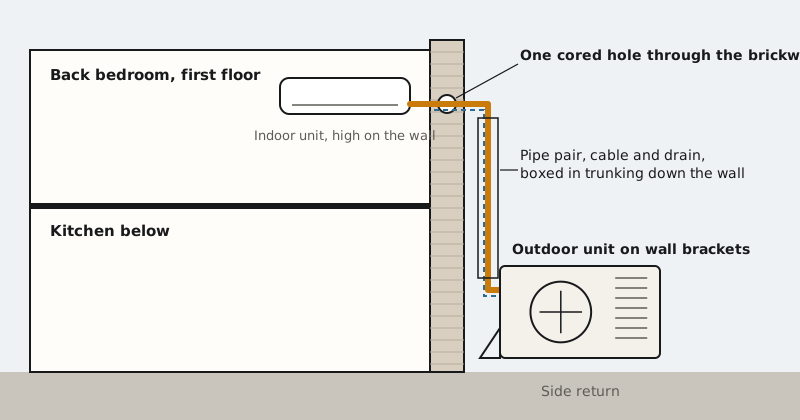
Sources: IOA and CIEH; Copeland Borough Council; Daikin.
What if a neighbour complains about the noise?
Passing the planning sum does not settle everything. Noise from premises that is prejudicial to health or a nuisance is a statutory nuisance under section 79 of the Environmental Protection Act 1990, and a council must take reasonably practicable steps to investigate a complaint. GOV.UK's test is whether the noise unreasonably and substantially interferes with the use or enjoyment of a home, or injures health or is likely to. Where a council finds a statutory nuisance it must serve an abatement notice; ignoring one can lead to prosecution and daily fines, and an appeal goes to the magistrates' court within 21 days. Sources: Environmental Protection Act 1990, section 79; GOV.UK.
How does Redbridge handle a noise report?
In stages. Redbridge Council asks residents to report noise through its online form and to keep a diary of each incident. It sends an advisory letter first, and an officer attends once there have been three or more confirmed reports about the same address within seven days. Formal action can follow as an abatement notice or a fixed penalty. A resident can also go to the magistrates' court directly under section 82, after giving at least three days' written notice for noise. The council's examples are music, licensed premises, building work, alarms and animals; air conditioning is not named, but the law covers noise from any premises. Neighbours over the borough line deal with their own council. Source: Redbridge Council.
Is there a standard for noise at night?
The World Health Organization's night noise guidelines of 2009 set a target of 40 dB for night-time noise outside homes, with 55 dB as an interim target where that cannot yet be met. That is a yearly average aimed mainly at traffic and community noise, not a limit for one appliance, and it is measured differently from the planning sum. It does give the 37 dB(A) figure some context. How we choose outdoor positions on Ilford streets is covered on our homepage for air conditioning in Ilford. Sources: WHO Europe; Grant UK.
Common questions
Can the outdoor unit go under my own bedroom window?
The planning sum is worked out at the neighbouring property's windows, so your own does not count towards it, but you will still hear the unit. We would rather find a spot that neither household sleeps above.
Is a heat pump louder in winter?
Slightly, on Daikin's sheet: its outdoor unit is 46 dB(A) at 1 metre in cooling and 47 dB(A) in heating.
Should I see the noise calculation?
Ask for it. It is a short sum, and since the permitted development right depends on it, it belongs with your paperwork.
What if the position fails the 37 dB(A) test?
Then the unit needs planning permission as it stands, or a different position, a barrier or a quieter model until the sum passes.
Sources for this page
- Mitsubishi Electric: data sheet for the MSZ-LN25VG2 and MUZ-LN25VG2 split, with power input, sound levels and refrigerant (June 2024, in French)
- Daikin: FTXM-R and RXM-R data sheet with sound levels and seasonal ratings (2021, published by the retailer Evomart)
- Fujitsu: specification for the ASYG KMCC wall units, with power input, seasonal ratings and indoor sound levels
- Institute of Acoustics and CIEH: professional advice note on noise from domestic air source heat pumps (2026)
- Grant UK: heat pumps and planning in England, including the 37 dB(A) limit (May 2025)
- Copeland Borough Council: heat pump noise calculation form under the original MCS 020 (December 2024)
- MCS: consultation response on MCS 020, setting the single 37 dB(A) limit
- Daikin: the RXM-R outdoor unit and its Silent setting
- legislation.gov.uk: Environmental Protection Act 1990, section 79 (statutory nuisances)
- GOV.UK: how councils handle statutory nuisance complaints
- Redbridge Council: reporting a noise nuisance
- WHO Regional Office for Europe: night noise guidelines (2009)
Five things to have handy
Answers to these let us judge, before anyone visits, how involved the job will be.
- Your postcode
- The building: terrace, semi, detached, a flat in a block or over a shop, or business premises
- Whether you own it outright, hold a lease or rent it
- Which room it is, its rough size, and whether it gets the morning or the afternoon sun
- Anything that limits outside changes: a conservation area, a listing, a lease clause or a managing agent
Want to talk about your own home or premises? Our page on air conditioning in Ilford sets out what we fit, how we look after it and where we work.
Services related to this guide
Air conditioning installation
Planned from survey to switch-on: a wall-mounted split, with the route, the wiring, the consents and the neighbours' window worked out before we drill.
Home air conditioning
For the bedroom that is still warm at midnight, the top-floor flat and the loft room: quiet indoor units that heat the same space in winter.
Air conditioning repairs
No cooling, water on the floor, frosted pipes or a flashing code: the cause found first, then a price.
More guides
Air conditioning costs: fitting, wiring and the bills that follow
National figures for the unit, the labour and the wiring, then the extras a lease, a landlord or a conservation area can bring.
What air conditioning costs to run, worked out at today's price cap
Pence per hour and pounds per summer for a 2.5 kW split, with winter warmth set against a fan heater and mains gas.
Does air conditioning need planning permission? The rules and the exceptions
When a unit counts as permitted development, and where Redbridge, Havering, Waltham Forest, Hackney and Chigwell differ.
No outdoor unit? Monoblocs, portables and splits compared
Through-wall monoblocs set against portables and splits, for flats and frontages that cannot carry an outdoor box.
Cooling a bedroom: sleep, quiet running and the right size of unit
Why bedrooms are the first room to cool, how quiet a unit runs on its lowest setting, and how big it needs to be.
Air conditioning in a loft conversion: heat, siting and pipe routes
The research on hot London lofts, what to try first, and how a unit and its pipes fit a dormer or a gable.
Sizing an air conditioner: kilowatts, BTU and the room in front of you
Two published sizing tables side by side, the conversion between them, and what changes the answer.
Checking the F-gas register before you hire an air conditioning firm
The firm's certificate, the engineer's own qualification, how to check both, and where R32 sits in the leak-check rules.
Rather we called you?
Your name, phone number and postcode are all we need to call you. A word about the room helps us come prepared. You can also call 020 8176 6154.